Twelve years of institutional risk management. Applied to fleet operations for the first time.
For twelve years, Jacob Reinhart was a derivatives trader and Quant in global options, futures, equity, and cash bond markets — the instruments that price risk at institutional scale. The kind of work where imprecision isn't a performance problem. It's a capital problem. Where the cost of not knowing your exact exposure, your break-even, your term structure of risk — is paid immediately, in real money, at a speed that doesn't allow for second opinions.
He studied for that world in undergrad: economics, finance, and applied statistics. He trained for what came after in graduate school: applied machine learning and AI. And for twelve years, he applied microeconomic analysis, theoretical pricing, and risk modeling to decisions that most people in those markets were making on instinct, experience, and gut feel.
Then he left. After mastering institutional risk management at the highest level, Jacob walked away from a lucrative trading career to pursue the next frontier: data science, machine learning, and AI systems architecture. The frameworks — the cognitive infrastructure built over a decade of having to be right about risk or pay for it — don't leave you when you walk away from the trading desk. They become the way you see the world.
Jacob started noticing Turo hosts in online communities. Power Hosts with fleets of 10, 20, 50 vehicles — people who had built real businesses generating $50,000, $200,000, $1,000,000 in annual revenue — making capital decisions with the analytical rigor of a coin flip.
Not because they were unsophisticated. Because they were operating without instruments.
They were asking online host groups whether to buy a Mercedes GL or an ML. They were setting monthly discounts at 45% without knowing their break-even daily rate. They were tracking gross revenue on the Turo dashboard and calling it profit. They were filing damage claims without knowing what the incident had actually cost them net of the payout, net of the lost revenue, net of the repair downtime.
Every one of these was a problem Jacob had seen in a different form, in a different market, at a different scale. The instruments for solving them existed — in trading, in quantitative finance, in risk management. Nobody had built them for this market.
So he did.
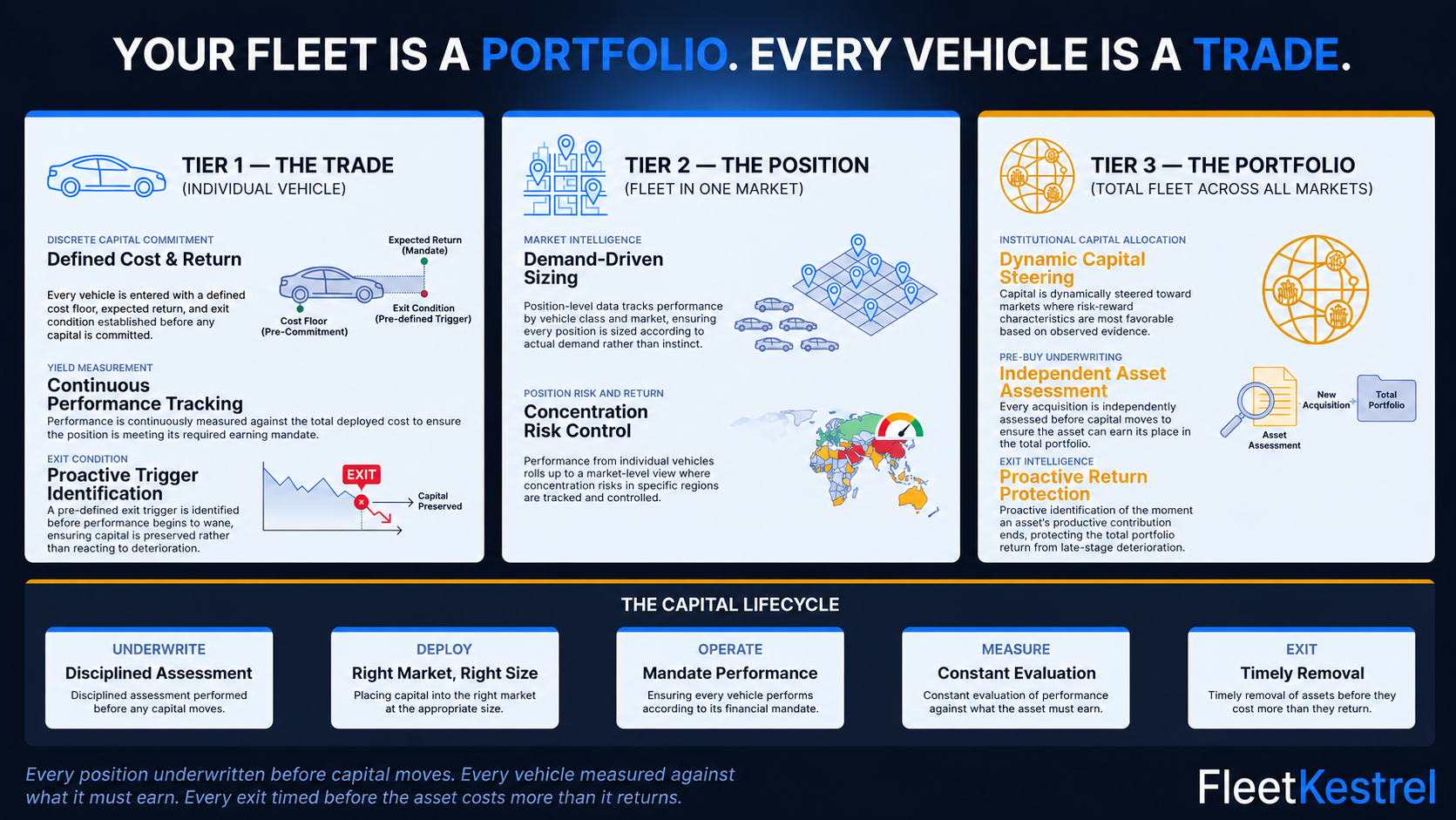
FleetKestrel is what happens when a derivatives trader, a Quant, a data scientist, and a machine learning engineer looks at the fleet operator community and asks: what if every operator could make decisions the way a portfolio manager does? Not a dashboard. Not a bookkeeper. A risk-adjusted capital allocation system — built for the operator who is ready to run their fleet like a business instead of a side hustle.
When a FleetKestrel user sees their MDR floor for the first time, they are not just seeing a number. They are inheriting twelve years of derivatives trading and quantitative research logic applied to their specific vehicle, their specific market, and their specific cost structure. They are learning to price decisions the way a trader prices risk. And they are benefiting from that education every time they use the product.
That is the origin of FleetKestrel. And it cannot be replicated by someone who hasn't had risk management burned into their cognitive framework, one position at a time, over a decade of doing it at institutional scale.
A kestrel is the only bird that can hover completely motionless in wind. While its body adjusts to the turbulence around it, its head holds perfectly still. It sees the ground below with extraordinary precision — tracking, calculating, waiting. Then it strikes exactly where it needs to.
It doesn't chase. It doesn't guess. It locks on, waits for certainty, and acts with precision.
While every other fleet operator is reacting — checking dashboards, posting in host groups, guessing why revenue dropped, making acquisition decisions by community poll — FleetKestrel holds still, sees everything clearly, and tells you exactly where to act and when.
The name was chosen because it describes both the product and the founder's method of working: patient, precise, and never in a hurry to act before the data is clear.
Other fleet management tools were built by Turo host veterans. They understand operational pain because they lived it. FleetKestrel was built by a derivatives trader, Quant, and risk manager who evolved into a data scientist, machine learning engineer, and AI systems architect. He understands the cost of imprecision because imprecision used to cost him money in real time, at scale, in markets that don't forgive errors.
That is not the same product. That is not the same intellectual foundation. And it cannot be replicated by someone who hasn't spent a decade having risk management burned into their cognitive framework one position at a time.
| Other Fleet Tools | FleetKestrel | |
|---|---|---|
| Built by | Turo host veterans | Veteran derivatives trader + Quant + ML engineer |
| Core framework | Operational experience | Risk-adjusted capital allocation |
| What it shows you | What you earned | What you kept — and what you're risking |
| Mental model | Host optimization | Portfolio management |
| Education layer | Feature documentation | Framework transfer |
| Intellectual moat | Operational know-how | 12 years institutional risk management |
FleetKestrel launched with Turo as its primary channel. It was built to be platform-agnostic from day one. The MDR floor doesn't care whether a trip was booked on Turo, Wheelbase, or through a direct rental agreement. The capital recovery curve doesn't care which platform generated the payout. The depreciation schedule doesn't care which channel produced the utilization.
Fleet intelligence operates at the vehicle level. Not the platform level. This was an architectural decision made at the beginning of development — not a retrofit. Jacob Reinhart, watching the fleet operator community grow increasingly concerned about platform dependency, platform changes, and the volatility of peer-to-peer marketplace economics, built FleetKestrel to be the tool that travels with the operator, not with the platform.
If you're running Turo today and Wheelbase tomorrow, or building your own direct rental business, FleetKestrel moves with you. Your data stays with you. Your intelligence stays with you.
Twelve years in global options, futures, equity, and cash bond markets — pricing risk at institutional scale. The cognitive framework that comes from a decade of having to be right about risk, or pay for it immediately, in real money.
Graduate training in applied machine learning and AI. The technical infrastructure to turn quantitative frameworks into production systems — deterministic engines that generate repeatable, auditable analytical outputs.
Designed and built the multi-agent LLM orchestration architecture underlying FleetKestrel's analytical engine — a system that applies institutional risk management logic to fleet capital decisions at scale.
Undergraduate training in economics, finance, and applied statistics, augmented by deep work in quantitative modeling and optimization — the domain that bridges mathematical rigor and operational decision-making. The same toolkit that powers industrial engineering and supply chain optimization, applied to fleet capital allocation.
FleetKestrel is the flagship product of LabFactory AI LLC, founded in La Grange, Illinois. LabFactory AI builds applied AI systems at the intersection of quantitative finance, machine learning, and operational intelligence.